
Why Do Benzodiazepine Screens Miss So Much?
For healthcare organizations and professionals (B2B) · Physician-led · Updated 2026-07-12 · CLIA #45D2048957 · CAP #8722734
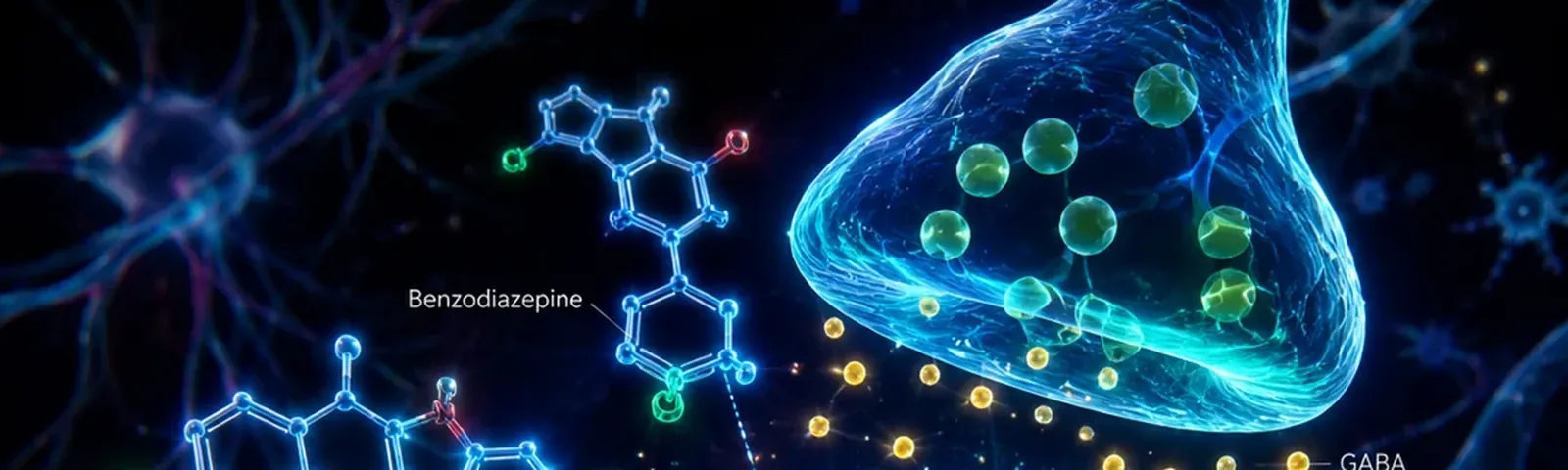
A negative benzodiazepine screen is weak evidence. Coverage across the class is genuinely uneven.CLIA #45D2048957 · CAP #8722734 · Same-day results · Walk-ins welcome
Three reasons that compound each other. The class is metabolically diverse — different agents produce different metabolites, and immunoassays are calibrated against a limited subset. Potency varies widely, so a highly potent agent may be present at concentrations below the cutoff. And designer benzodiazepines may not be recognized by the antibody at all. The consequence: a negative screen is not evidence of abstinence.
Where the screen fails
| Issue | Effect |
|---|---|
| Metabolic diversity across the class | Assay may not recognize the actual metabolite present |
| High potency agents | Therapeutic concentrations may fall below screening cutoffs |
| Designer / novel benzodiazepines | Frequently outside immunoassay coverage entirely |
| Glucuronide conjugation | Hydrolysis may be required for detection |
If a patient reports taking a benzodiazepine and the screen is negative, the most likely explanation is the assay — not the patient lying about taking their own prescription.
What definitive testing does
LC-MS/MS targets the specific parent drugs and metabolites, with quantitation — which is what makes adherence assessment possible rather than speculative. See medication monitoring.
FAQ
- So a negative means nothing?
- It means much less than people assume. In a consequential setting, confirm.
- Which benzodiazepines does your panel cover?
- We will give you the explicit analyte list. A laboratory that will not is telling you something.
- Do you detect designer benzodiazepines?
- Coverage is defined and stated. We do not claim to detect everything that exists.
- Turnaround?
- See turnaround and logistics.
References
- ASAM — Appropriate Use of Drug Testing in Clinical Addiction Medicine
- CDC — Clinical Practice Guideline for Prescribing Opioids (2022)
- Our CLIA #45D2048957 and CAP #8722734 credentials — verify them yourself
Reach us — privately
No name needed to ask a question. Text is the fastest way to reach us.
Or send your details below — we will reply by text or email during open hours.